

Management of Biogenic CO2: BECCUS strategic project (Phase 2)
This project aims to 1) facilitate cross-sector learning on bio-CCUS, 2) shed light on (bio)energy system integration and deployment of bio-CCUS and 3) address CO2 mitigation potential of bio-CCUS. It will allow for a more systemic consideration of how to take different bio-CCUS or BECCUS applications to deployment.
There have been previous activities on bioenergy and carbon capture and storage by IEA Bioenergy with a particular focus on first-of-its-kind projects. Publications can be found here.
Participating Tasks
8 out of 11 IEA Bioenergy Tasks participating. Task 40 (deployment), Task 32 (combustion), Task 33 (gasification), Task 34 (DTL), Task 36 (waste), Task 37 (biogas), Task 44 (flexibility) and Task 45 (sustainability).

Duration
01/06/2022 – 31/12/2024
Leadership
Christiane Hennig (Task 40, DBFZ, Germany), Christian Bang (Task 40, EA Energy Analyses, Denmark)
Objective
Key questions that are addressed:
- Which technologies/concepts are (potentially) available?
- What are the requirements for the deployment of BECCUS?
- In a given situation should biogenic CO2 be sequestered, or utilised?
- How to monetise the carbon negative products that bioenergy can deliver?
- How is the GHG accounting for the different concepts? How to govern the different energy system services?
Work packages
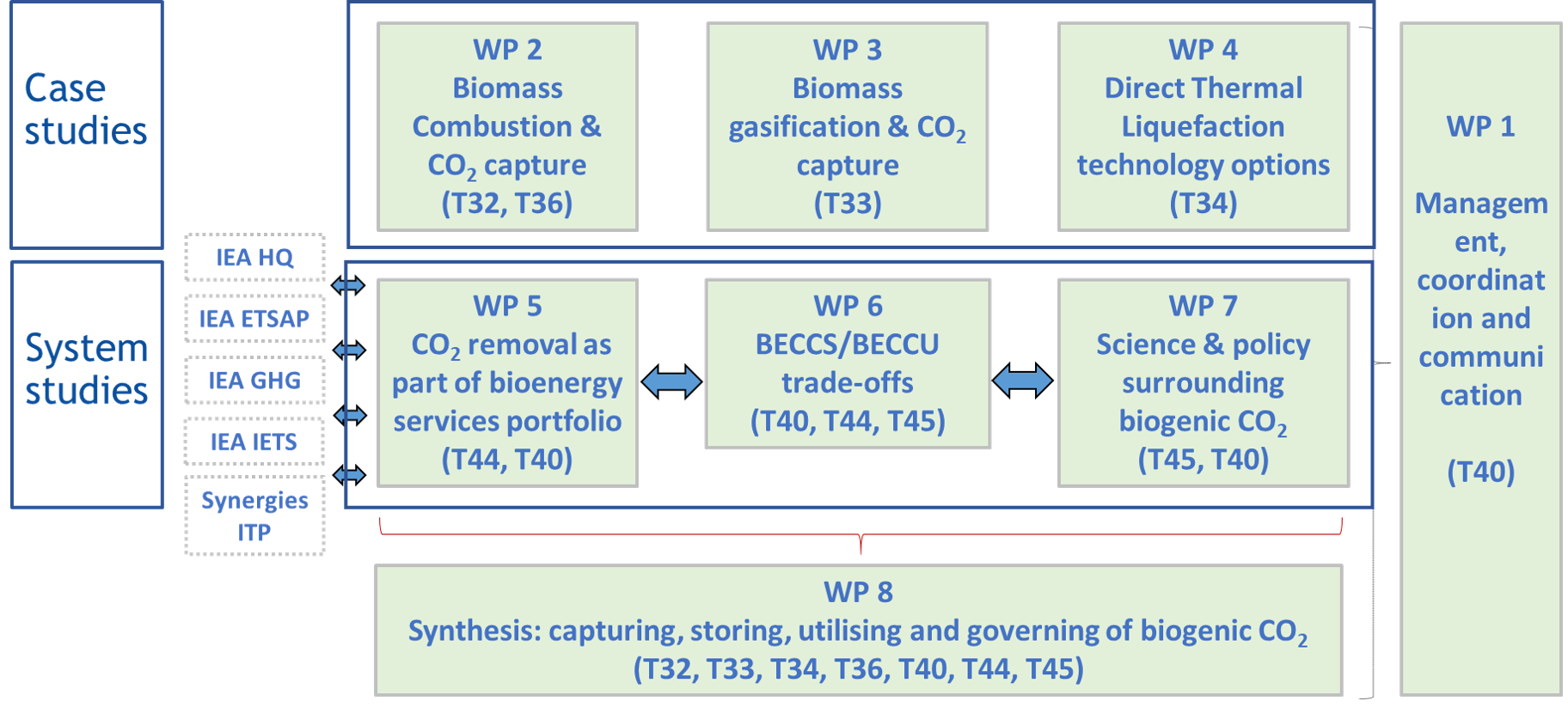
Publications
Work Package 2 – Biomass combustion and CCUS projects
Biomass District Heating Plant in Ottawa, Ontario
This case study report assesses technically feasible carbon capture and utilization (CCU) technology options for a small-scale biomass district heating demonstration plant. Using the 1.5 MWth Biomass District Heating Plant in Ottawa, Canada, as a reference case, the study evaluates post-combustion and advanced capture technologies as well as CO₂ utilization pathways based on their technology readiness levels, energy demand, and integration requirements. The analysis aims to identify CCU solutions capable of meeting the CO₂ capture targets of the reference facility while minimizing additional power consumption and operational impacts on the existing plant infrastructure.
Key Lessons:
- The technology options analysis concluded that viable CO₂ capture technologies exist that can achieve the target capture rates, but their implementation will require additional power consumption and careful heat integration of new facilities with the existing plant.
- Deployment of CO₂ capture technologies will involve substantial capital investment and increased operations and maintenance costs.
- Significant reductions in CO₂ emissions from the facility are expected, and accounting for this mitigation potential in project planning will support the achievement of climate goals.
View the publication here:
Modelling full-scale implementation of CCUS at large wood chip fuelled CHP plant in Denmark
This case study report presents the latest developments regarding the Skærbæk CHP plant in Denmark, a major district heating provider that delivers heat to several towns in western Denmark, including Vejle, Kolding, Fredericia, and Middelfart. The plant currently uses approximately 550,000 tonnes of wood chips per year and is exploring the integration of CCUS technology to reduce its carbon footprint. The study aims to evaluate the consequences of investing in CCUS technology at the plant.
Key Lessons:
- Importance of scenario planning and evaluation: The study demonstrates that analyzing different scenarios (BAU, CCS, CCUS) helps to understand the implications of investing in CCUS technology.
- Infrastructure and organizational needs are crucial: Integrating CCUS technology requires careful planning and implementation, particularly with regards to energy consumption, storage, and transportation.
- Market conditions and pricing play a significant role: The study’s results show that market conditions and prices for CO2 and energy affect the economic viability of CCUS technology.
- Complexity of integrating new systems into existing operations: Integrating CCUS technology into existing facilities is complex and requires careful coordination of processes and systems.
- Energy-intensive nature of CCUS processes: The study shows that CCUS processes are energy-intensive and require significant amounts of energy, which must be covered by external energy sources.
View the publication here:
Full-scale Waste-to-Energy CCS in Norway
This case study report presents the latest developments regarding the Hafslund Celsio full-scale CCS project at their Klemetsrud WtE plant in Oslo, Norway. The project has been initiated in 2015 and went through different stages of project realisation since then. The purpose of this report is to present the different stages and challenges and to derive lessons learnt of developing this kind of BECCS project.
Key Lessons:
- Importance of perseverance, patience, and thorough evaluation.
- Infrastructure and organizational needs are often underestimated. Especially the provision of electricity, transport, the significant need for space (especially challenging in urban settings) and a temporary storage at the harbour.
- Political or societal support are key.
- Integrating new systems into existing operations proves to be complex, and managing various levels of process maturity is challenging. In the particular case on hand a bold cost-cutting phase helped to revitalize the project.
View the publication here:
- Full-scale Waste-to-Energy CCS in Norway: Oslo CCS Hafslund Celsio, WP2 Case Study Report (May 2025)
Work Package 3 – Biomass gasification & CO2 capture
This case study investigates the carbon dioxide removal (CDR) potential of decentralised utilisation BECCUS systems, specifically focusing on hydrogen production in small-scale gasifiers using waste wood via gasification with carbon capture, utilisation and storage. Through process modelling and lifecycle assessment, the study evaluates the flexibility, scalability, and immediate applicability of this BECCUS pathway with the aim of quantifying its CDR potential and assessing its contribution to the UK’s net-zero targets. To understand the potential for Carbon Dioxide Removal (CDR) and net emissions of Bioenergy with BECCUS, we need to look at the entire supply chain. This includes everything from growing and sourcing the biomass to how the captured CO2 is stored or used.
This case study also highlights the importance of policy frameworks that prioritise carbon efficiencies, which can influence operational decisions and impact the overall performance of BECCUS systems. This includes the biogenic CO2 contained in the biomass and captured during conversion, as well as all emissions associated with land, crop, or forest management, harvesting, biomass processing, storage, and transport at every stage of the supply chain. Additionally, it encompasses emissions from the biomass-to-energy conversion and CO2 capture processes, as well as any emissions related to the transport, storage, or use of the captured CO2.
Key findings
- Sustainable biomass gasification with carbon capture can simultaneously deliver low-carbon hydrogen and durable carbon removals, demonstrating a pathway that supports both industrial decarbonisation and net zero objectives.
- Prioritising waste and residual biomass feedstocks can maximise climate benefits while reducing risks associated with land use change, biodiversity impacts and competition for resources.
- The key barriers are no longer technical capability but investment certainty, CO₂ transport and storage infrastructure, and route-to-market arrangements for low-carbon hydrogen and carbon removals.
- Recognising and rewarding carbon removals alongside low-carbon hydrogen production could strengthen project economics and support investment in early commercial-scale biohydrogen with CCS facilities.
View the publication here:
Work Package 6 – BECCS/BECCU trade-offs
Bioenergy combined with carbon capture represents a critical pillar in achieving net-zero and ultimately net-negative emissions. BECCS offers permanent carbon removal, while BECCU contributes to fossil carbon substitution through the creation of renewable fuels and materials. Determining “when to store and when to utilise” depends on economic, policy, technological and infrastructural factors. The report analyses these dimensions from the perspective of CO₂-emitting sites, guided by emerging policy frameworks and early implementation experiences in Sweden, Denmark, and Norway.
Key findings:
- BECCS is indispensable for achieving net-negative emissions and offsetting residuals in hard-to-abate sectors.
- Stable, long-term funding mechanisms, such as reverse auctions or subsidies per tonne CO2 sequestered, are critical to accelerate deployment. EU funding, for example EU Innovation fund or similar, can also provide vital revenue streams.
- Private-public partnerships are proving decisive -linking corporate offtakes with public support to unlock bankable projects.
- Policy coherence across the CRCF, ETS, RED, and industrial carbon management frameworks is essential to prevent conflicting incentives.
- Cross-border CO2 transport and storage agreements (e.g. between Sweden, Denmark, and Norway) are enabling first regional BECCS value chains.
- Various revenues streams can support a successful realisation of BECCS projects, including: (1) Specific state support mechanisms (i.e. per tonne CO2 subsides), 2) broader R&D support (i.e. EU Innovation fund), 3) voluntary carbon markets (i.e. CDRs)
- Current business models favour BECCS. BECCU provides transitional value, sufficient willingness-to-pay for e-fuels has yet to materialise.
View the publication here:
Work Package 7 – Science and Policy around bio-CCUS
Despite its potential as carbon dioxide removal practice with high technology maturity and high permanence of storage, BECCUS is not yet systematically integrated into most national climate and energy policies, partly due to misconceptions about its effectiveness. Frontrunner countries like Denmark and Sweden are exceptions, actively implementing policies such as public tenders and reverse auctions to support commercial deployment.
Stronger policy frameworks are urgently needed to scale up BECCUS, clarify definitions, and provide financial incentives to realise its full potential in building a sustainable, climate-neutral future.
Key Highlights:
- BECCS is essential for meeting national climate targets. Scenario modelling shows that achieving net-zero emissions by 2050, especially in countries with significant agricultural emissions, will be extremely challenging, if not impossible, without the negative emissions provided by technologies like BECCS..
- Urgent and clear policy support is needed to drive commercial deployment. While the scientific case for BECCUS is strong, its large-scale implementation is hindered by a lack of supportive policy frameworks in most countries. Learning from frontrunners like Denmark and Sweden, policymakers should implement mechanisms such as reverse auctions, carbon removal certification frameworks, and direct financial support (e.g., CCUS Funds) to create viable business models, reduce investment risk, and accelerate the scaling of these critical climate solutions.
- Crucial aspect to be addressed in the process of policy making: Cascading biobased value chains—using biomass for products like particleboard before energy generation—can delay CO₂ release, buying time for BECCS technology to scale up and maximising the climate benefits of each unit of harvested biomass.
View the publication here:
BECCUS Science & Policy. WP7 Summary Report (May 2025)
Journal article – BECCUS strategic project: Phase 2
As an outcome of the BECCUS 2.0 project, conducted in collaboration with IEA Bioenergy Task 45 and the University of Galway, a new study published in Nature’s Communications Earth & Environment reveals that cascading wood use—prioritising material applications before using residues for BECCS—achieves stronger and longer-lasting global cooling. The analysis highlights the vital synergy between cascading strategies and BECCS for resilient, net‑zero carbon removal.
Dissemination and Events
Intra-Task Meeting IEA IETS Task XI on Industry-Based Biorefineries for Sustainability, Gothenburg 8 May 2023, Bang_IEABioenergy-2023_05.08
EERA event “Carbon sinks in Europe: stakeholders taking action to bring out the next solutions for carbon neutrality“, Brussels, 5 September 2023, Hennig_IEABioenergy-2023_09_05_EERA
Project workshop organized by IEA Bioenergy Task 32 “Biomass combustion and CCUS“, Copenhagen, 21 September 2023, Bang_intro-Task-32-Workshop-Biomass-Combustion-and-CCUS
IEA Bioenergy Workshop WS30 “Bioenergy in a Net Zero Future“, Lyon, 19 October 2023, Download
Project Workshop “Science and policy surrounding biogenic CO2”, online, 2 February 2024
Workshop IEA IETS Task 21 Subtask 2 Circular Carbon, “Widening the perspective on Circular Carbon: from potentials to practical experience”, online, 29 February 2024
Advanced Bioeconomy Leadership Conference (ABLC 2024), Washington DC, 13-14 March 2024, Download
Workshop IEA TCP Coordination Group on Carbon Management, 22 April 2024
Webinar “Utilization and storage of captured biogenic CO2 – Deployment in selected EU countries”, 17 June 2024, Announcement and Recording
BBEST & IEA Bioenergy Conference 2024, São Paulo, 22-24 October 2024, Presentation
Overview of major planned first-of-its-kind BECCUS projects in Europe (status 10/2024)
| Project/company | Location | Type of primary energy facility | Facility capacity | Feedstock | Capture rate biogenic CO2 Mt/a | Project phase |
| Asnæs 6 CHP Station /Ørsted | Denmark | Biomass combustion | 25 MWel, 129 MWth | Wood chips | 0.28 | implementation |
| Avedøre Power Station /Ørsted | Denmark | Biomass combustion | 100 MWel | Straw | 0.15 | implementation |
| Amagerværket4/ Hofor | Denmark | Biomass combustion | 150 MWel, 415 MWth | Wood chips | 1.1 | planning |
| BECCS Stockholm/ Stockholm Exergi | Sweden | Biomass combustion | 130 MWel, 280 MWth | Wood chips | 0.8 | planning |
| Jordbro/ Vattenfall | Sweden | Biomass combustion | 279 MWth, 20 MWel | Wood chips, waste wood | 0.15 | planning |
| Hafslund Celsio/ Hafslund | Norway | Waste-to-energy (50% biogenic share) | 55.4 MWth, 10.5 MWel | Municipal waste, waste from industry | up to 0.2* | planning |
| Emshaven/RWE | The Netherlands | currently: co-firing (15%); in 2030: 100% biomass | 2 x 785 MWel | Hard coal (currently), wood pellets, agro pellets | 8-10 | planning |
| Amer/RWE | The Netherlands | currently: co-firing (80%); in 2025: 100% biomass | 645 MWel, 350 MWth | Hard coal (currently), wood pellets, agro pellets | 3-4 | planning |
Notes: * Hafslund Celsio: Capacity of the capture unit is 400 kt/year. Assuming 50% biogenic fraction. Disclaimer: No guarantee for completeness.
References:
https://orsted.com/en/what-we-do/renewable-energy-solutions/bioenergy/carbon-capture-and-storage
https://orsted.com/en/media/news/2021/06/857452362384936
https://www.ieabioenergy.com/wp-content/uploads/2021/05/Bang-FINAL-2021-IEA-Bio-BECCUS-HOFOR.pdfhttps://www.hofor.dk/baeredygtige-byer/fremtidens-fjernvarme/amagervaerket/co2-fangst-paa-amagervaerket/
https://kommunikasjon.ntb.no/pressemelding/17964354/karbonfangstprosjektet-pa-klemetsrud-gjennomforer-en-kostnadsreduserende-fase?publisherId=17848166&lang=no
https://kommunikasjon.ntb.no/pressemelding/18114100/hafslund-oslo-celsio-verdens-forste-samarbeidspartner-for-net-zero-plastic?publisherId=17848223&lang=no
https://www.hafslund.no/en/produkter-og-tjenester/oslo-ccs/prosessen-med-a-fange-og-lagre-co2-fra-klemetsrudhttps://ccsnorway.com/capture-hafslund-celsio/
https://www.ieabioenergy.com/wp-content/uploads/2021/05/Becidan-2021-FINAL-IEA-Bio-BECCS-FOV-Case-study.pdfhttps://www.stockholmexergi.se/en/bio-ccs/
https://beccs.se/news/stockholm-exergis-project-for-negative-emissions-receives-eu-support-2/https://beccs.se/news/stockholm-exergi-announces-permanent-carbon-removal-agreement-with-microsoft-worlds-largest-to-date/
https://group.vattenfall.com/press-and-media/newsroom/2024/vattenfall-takes-major-step-towards-negative-emissions-in-jordbrohttps://group.vattenfall.com/sustainability/climate-transition-plan/carbon-capture
https://powerplants.vattenfall.com/jordbro/
https://benelux.rwe.com/en/press/2022-12-12-rwe-launches-project-beccus-for-large-scale-capture-and-storage-of-co/
https://benelux.rwe.com/en/our-energy/biomass/beccus/
https://benelux.rwe.com/en/locations-and-projects/amer-power-plant/
https://benelux.rwe.com/en/locations-and-projects/eemshaven-power-plant/